How to play
Xiangqi
Two generals. One river between.
How to play Xiangqi — the rules in plain words, in the order a beginner needs them, and the story of where the game comes from.
- Origin
- China
- Era
- c. 800 CE
- Players
- Two
- To learn
- 8 min

The rules of Xiangqi
In the order you need them. Each part takes a few minutes, and nothing in a later part is needed to understand an earlier one.
Part 1 · 2 min
Palace and general
Where the game is set and who stands at its centre — a river between two camps, a 3×3 palace, and the one piece that must never leave it.
A river between two camps
The board is a nine-by-ten grid of intersections, with a river running across the middle. Pieces stand on intersections, not squares. Red moves first.
The general never leaves his palace
Each camp has a marked 3×3 palace. The general moves one step at a time, orthogonally — but he must stay inside the nine palace points.
Part 2 · 4 min
The pieces that strike from far
Chariot, cannon, horse, elephant — four pieces, four very different ways to hit the same enemy palace.
The chariot rules straight lines
The chariot slides any distance along a row or column — exactly like a chess rook. It's the strongest mover in the game.
The cannon slides too
The cannon moves like the chariot — straight lines, any distance — when it's not capturing. Empty path, empty destination, slide.
But it captures by leaping
To capture, the cannon must jump exactly one piece — any colour — between itself and the target. No piece, or two pieces, and the capture is illegal.
Two more — the horse and the elephant
The horse moves like a chess knight, but its path can be blocked: any piece on the cell next to it (in the direction it's leaving) stops the jump.
The elephant moves exactly two diagonal steps at a time and never crosses the river. Each side has two elephants that defend their own camp.
Part 3 · 2 min
Soldier, river, and how it all ends
The piece that walks one step at a time, the river that promotes it, and the two quiet rules that decide who wins.
Soldiers go forward — and grow up at the river
A soldier moves one point forward at a time. Until it crosses the river. After the river, it can also step sideways. Soldiers never go back.
How games end
The game is won by checkmate or stalemate: trap the opponent's general so it can't escape capture, or leave them with no legal move at all.
There's one bonus rule worth knowing: the two generals can never face each other on the same open file. If your move would leave them face to face, the move is illegal.
Where Xiangqi comes from
“My strength uprooted mountains. My spirit covered the world. But the times are against me.”
China, 206 BCE
After fifteen years of tyranny, the Qin Empire collapses.
Two men rise from the chaos. Xiang Yu, a nobleman of Chu — the greatest warrior of his age, raised on stories of empire. Liu Bang, a peasant from Pei County — a sheriff who befriended anyone he met.
One was born to rule. The other learned how.
The Banquet at Hongmen
That same year, Xiang Yu invited Liu Bang to a feast.
They drank, they toasted, they pretended to be friends. But Xiang Yu's advisors had planned an assassination — a sword dance that would end with Liu Bang dead at the table.
Liu Bang sensed the trap and escaped through the kitchen. Xiang Yu let him go. He would regret it for the rest of his life.
The Battle of Pengcheng
War broke out within months.
In the spring of 205 BCE, Liu Bang gathered a coalition of 560,000 soldiers and seized Xiang Yu's capital at Pengcheng. The war seemed already won.
Xiang Yu rode back with 30,000 men. By the end of the day, the Han coalition was scattered. Liu Bang himself barely escaped alive — his children thrown from the chariot to lighten the load.
No one in China would forget what Xiang Yu could do on a battlefield.
The Treaty of Hong Canal
For three more years, they tore China apart.
By 203 BCE, both were exhausted. Xiang Yu's supply lines were broken. Liu Bang's father and wife had been Xiang Yu's hostages for over a year.
They signed a treaty. China would be split in two. A canal — the Hong River — would mark the border. Xiang Yu's Chu to the east. Liu Bang's Han to the west.
Two armies. Two kings. One river between them.
Songs of Chu
Liu Bang broke the treaty within months.
He surrounded Xiang Yu at Gaixia. That night, the Han soldiers sang the folk songs of Chu through the darkness. Xiang Yu heard the voices of his homeland in the enemy camp — and believed all was lost.
The Wujiang River
Xiang Yu wrote a final poem for his beloved Yu Ji.
Then he rode out with 800 men.
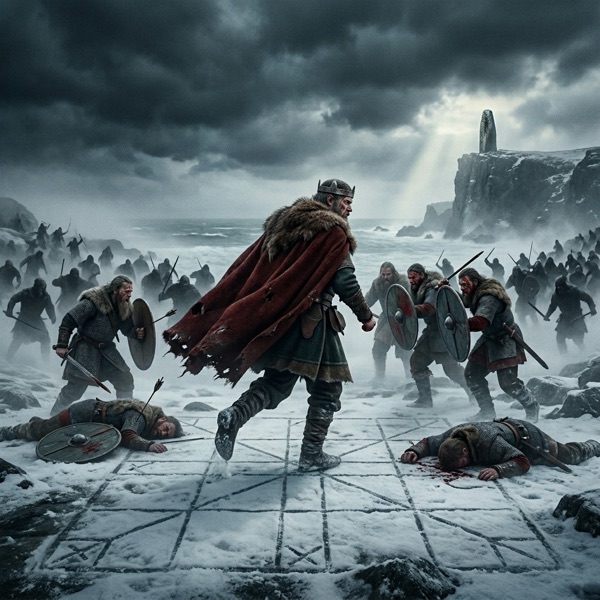
By dawn, 28 remained. By dusk, none. At the Wujiang River, a boatman offered him passage home — but Xiang Yu refused. He could not face the elders of Jiangdong after losing the army they had given him.
He turned his horse loose, drew his sword, and ended the war himself.
What the people built
Liu Bang founded the Han Dynasty. It would last four hundred years — China's golden age.
But the people did not forget the war.
They built a game from it. The board is split by a river — still called the Chu and Han Border. The red side is Liu Bang's Han. The black side is Xiang Yu's Chu. And by ancient rule, the two generals can never face each other across the river. Because some wars never truly end.
Two thousand years later
The war goes on.
Every game of Xiangqi is the same conflict, fought again. Same river. Same generals. Same red and black.
You don't need to know the history. You don't need to choose a side. Just remember: every move is a piece of a story older than empires.
Begin.
Play Xiangqi with a real person.
Board and Pieces puts Xiangqi and ten other games of the world on one board — with your friends, your family, or whoever is sitting in the café. Free on iOS and Android.


Nobody near you yet?
Leave your city and an email. When there are players, or a café with a board, in your area, you hear about it first.