How to play
Bagh Chal
Sometimes the goats win.
How to play Bagh Chal — the rules in plain words, in the order a beginner needs them, and the story of where the game comes from.
- Origin
- Nepal
- Era
- c. 1500 CE
- Players
- Two
- To learn
- 9 min
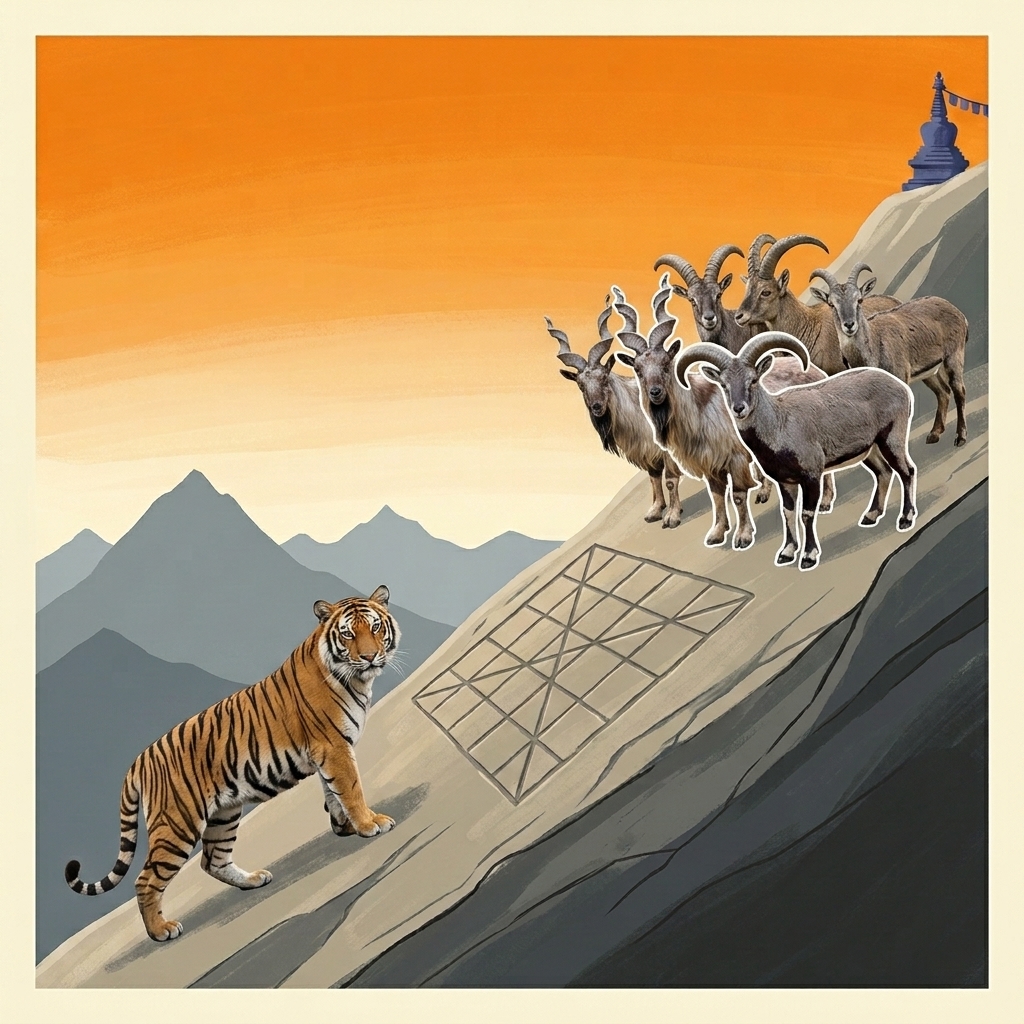
The rules of Bagh Chal
In the order you need them. Each part takes a few minutes, and nothing in a later part is needed to understand an earlier one.
Part 1 · 3 min
Two sides arrive
Tigers in the corners, goats arriving one by one — and the small habit that keeps your first goats from being snacks.
Two sides, two jobs
Four tigers in the corners. Twenty goats waiting to arrive. The tigers want to eat. The goats want to surround.
Goats arrive one at a time
Goats go first. For the first twenty turns, you just drop one new goat onto any empty intersection.
Don't drop a goat next to a hungry tiger
A tiger eats by jumping over a goat into an empty point right behind it. So a lone goat next to a tiger, with an empty point on the far side — that goat is gone next turn.
The defence is plain: place new goats so that the point behind them is already full, or so that they sit beside another goat. A pair of goats side by side is half a wall — and walls are how the goats win.
Part 2 · 3 min
Tigers slide and hunt
One quiet step, or one hungry jump — the two things a tiger ever does on its turn.
Tigers slide one step
On their turn, tigers slide along a line to a neighbouring empty intersection.
Tigers eat by jumping
If a goat sits next to a tiger and the point right after the goat is empty, the tiger can jump over the goat — and eats it.
Part 3 · 3 min
Diagonals and the goat's revenge
Where the diagonal jumps live, what it means to win, and the small wall-building move that closes a tiger's last door.
But only along real lines
Tigers can jump diagonally too — but only between the X-marked points, where the diagonal lines on the board actually exist. From a side-of-square point that has no X, the tiger has no diagonal: just up/down/left/right.
Two ways to win
Tigers win when they have eaten five goats. Goats win when every tiger is blocked — no slide, no jump. The goats lose individuals; the tigers lose space.
This is why placement matters so much. The early goats aren't fighting — they're building the walls that will, twenty turns later, leave every tiger with nowhere to go.
Where Bagh Chal comes from
“Sita is no match for me — neither in birth, nor in beauty, nor in amiability. But through infatuation, you do not see this.”
An old legend, from Lanka
Long before tigers and goats appeared on any wooden board, Queen Mandodari sat alone in her palace in Lanka. Her husband, the king Ravana, ruled an empire that would soon destroy itself. She had warned him. He had not listened.
So Mandodari devised a game. Four tigers, twenty goats. The hunter, and the hunted. She played both sides — that her wisdom might never sleep, even when no one would hear it.
Whether the legend is true or not, the game traveled. From Lanka, across India, into the Himalayas. By the time it reached the Newar villages of Nepal, it had a new name: Bagh Chal. The Tiger's Move.
Five lines crossing five
The board is simple. Five lines by five lines, plus the diagonals. Twenty-five points where they cross.
Four tigers — small brass figures, fierce, often hand-cast in the Newar metalworking tradition — sit at the corners. Twenty goats — simple stones or pellets — wait beside the board, ready to be placed one by one onto the points.
No dice. No hidden cards. Everything is visible. Everything matters.
What the strong forget
The tiger is strong. It jumps over a goat and eats it. A single tiger can devour the whole herd, one by one. The strength is real.
But the goat has something the tiger does not. It has numbers. And it has a quieter weapon: stillness. A goat that blocks a tiger's path does not need to fight. It only needs to stand there. If enough goats stand in the right places, the tiger cannot jump, cannot move, cannot eat.
A tiger that cannot move is a tiger that has lost. This is not a story about who is stronger. It is a story about what strength forgets.
What the grandfather teaches
High in the Kathmandu valley, a grandfather sits with his grandson on a wooden veranda. A brass Bagh Chal board between them. The boy is eight or nine. He plays the tigers, because he likes their teeth.
The grandfather plays the goats. Sometimes he plays badly, so the boy can win. Sometimes he plays well, to show the boy what he was missing — that a goat is not weak. A goat thinks ahead. A goat trusts the other goats. A goat learns the patience of the herd.
These are also the things a shepherd must know. The game is a rehearsal — for keeping animals safe, for living in mountains where real tigers still walk.
Sometimes the goats win
You don't need to be a shepherd. You don't need to live where tigers walk. You don't need to know the wisdom of an old queen in Lanka.
You only need to choose a side — the four strong few, or the twenty patient many — and to remember that the game does not ask which is better. It asks which one you understand.
Make your move.
Play Bagh Chal with a real person.
Board and Pieces puts Bagh Chal and ten other games of the world on one board — with your friends, your family, or whoever is sitting in the café. Free on iOS and Android.


Nobody near you yet?
Leave your city and an email. When there are players, or a café with a board, in your area, you hear about it first.


