How to play
Mū Tōrere
Four stones. Eight points. Endless thought.
How to play Mū Tōrere — the rules in plain words, in the order a beginner needs them, and the story of where the game comes from.
- Origin
- New Zealand
- Era
- pre-1800s
- Players
- Two
- To learn
- 6 min
The rules of Mū Tōrere
In the order you need them. Each part takes a few minutes, and nothing in a later part is needed to understand an earlier one.
Part 1 · 2 min
Two rules, eight points, one centre
The shape of the board, the one quiet rule about the centre, and the only way to lose.
Two rules, eight points, one centre
On your turn you slide one of your stones into an empty neighbour. That's the only kind of move there is. No captures, no jumps, no special pieces.
There's one quiet rule about the centre — the pūtahi. A stone may enter the centre only if one of its outer neighbours is an opposing stone. Without that rule, the very first move would just stash a stone in the middle and the game would freeze.
Whoever runs out of legal moves first, loses. That's the whole game.
Part 2 · 2 min
Why the centre matters
Why every game runs through the centre — and the survivor's eye that finds the one move the board still allows.
Why the centre matters
A stone in the centre touches every outer point. From there it can step anywhere there's an empty seat — eight choices instead of two.
And a stone can always leave the centre. The opposing-neighbour rule applies only to entering — once you're inside, the door swings both ways.
This is why fights for the centre decide most games. Take it first, hold it as long as you can, and slip out when you see a trap closing.
Part 3 · 2 min
The squeeze
How a single move can end the game — from the attacker's side, and from the defender's.
How games end
Mū Tōrere has no captures, no king, no checkmate. The game ends the moment one player has no legal move on their turn — every one of their stones is boxed in by friends, enemies, or the empty centre they aren't allowed to enter.
Most games are decided by a single tight squeeze in the middle of the board. A perfect player can force a draw, but in practice a moment of distraction — one stone in the wrong place — is enough to lose.
Now look at this position. It's your turn, and there's a single move that wins the game on the spot.
And from the other side
Every trap has a moment just before it closes. If you're the defender and you spot it in time, sometimes there's a single quiet move that lets you slip out — and the game keeps going.
Where Mū Tōrere comes from
“Ahakoa he iti, he pounamu. — Although it is small, it is greenstone.”
An eight-pointed star
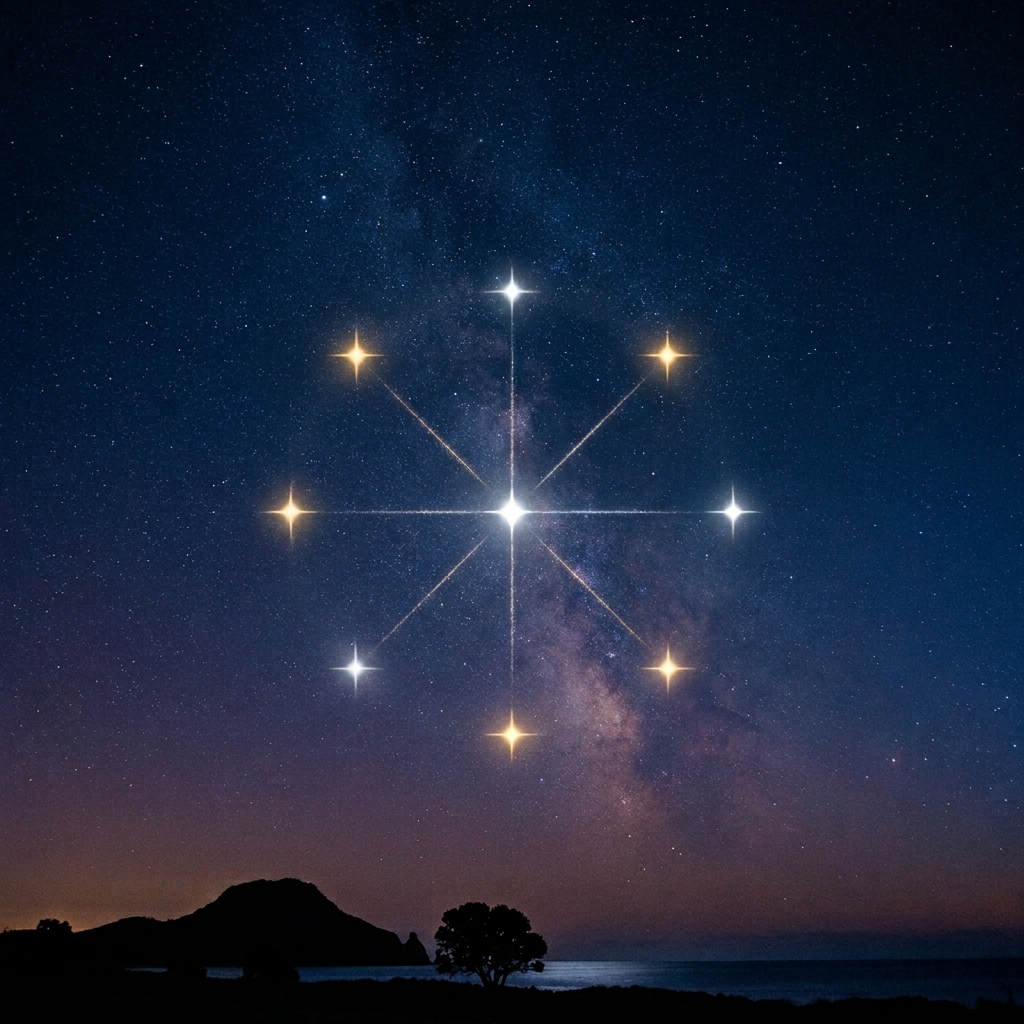
The Mū Tōrere board is shaped like a star. A center — pūtahi. Eight points around it — kewai. That is all.
Each player has four stones. One starts on each of four touching points. The game asks one thing: can you move while leaving your opponent no move to make?
There is no dice. No capture. No king. Just four stones, eight points, and the small space between them where thought has to live.
Carved by hand, taught by voice
Mū Tōrere is, as far as we know, the only board game the Māori people invented for themselves. It was not brought across the ocean. It was born in Aotearoa.
The boards were small — carved into wood, sometimes scratched into the earth, sometimes shaped from a flat piece of pounamu (greenstone). The pieces were stones, shells, seeds. The rules were never written down. They were given, mouth to ear, from elder to child, on long evenings.
How can so little do so much?
Eight points. Four stones each. It seems too simple to be interesting.
And yet — modern mathematicians have studied Mū Tōrere and found something quietly astonishing. The game has roughly ninety-two distinct positions. A perfect player can force a draw, but the path to that draw is far from obvious. A careless move loses. A clever move opens a door the opponent did not see.
The whakataukī is right. Ahakoa he iti, he pounamu. The small thing is the precious thing.
Almost lost. Not lost.
For most of the twentieth century, Mū Tōrere was barely played. The colonial school system did not teach it. English-language games — chess, draughts — took its place.
But it never quite disappeared. Some families kept it. Some kaumātua (elders) carried the rules in memory. When the Māori Renaissance began in the 1970s — reviving te reo Māori, the language; reviving the songs, the carvings, the stories — Mū Tōrere was lifted up again. Today it is taught in schools across Aotearoa.
Eight points. Four stones. A game that almost forgot itself, and then remembered.
Four stones. Eight points. Endless thought.
You don't need to speak te reo Māori. You don't need to know where Aotearoa is on a map. You don't need much.
Just four stones. Eight points. And the small quiet space between them where every move matters.
Move one stone.
Play Mū Tōrere with a real person.
Board and Pieces puts Mū Tōrere and ten other games of the world on one board — with your friends, your family, or whoever is sitting in the café. Free on iOS and Android.


Nobody near you yet?
Leave your city and an email. When there are players, or a café with a board, in your area, you hear about it first.


