How to play
Hnefatafl
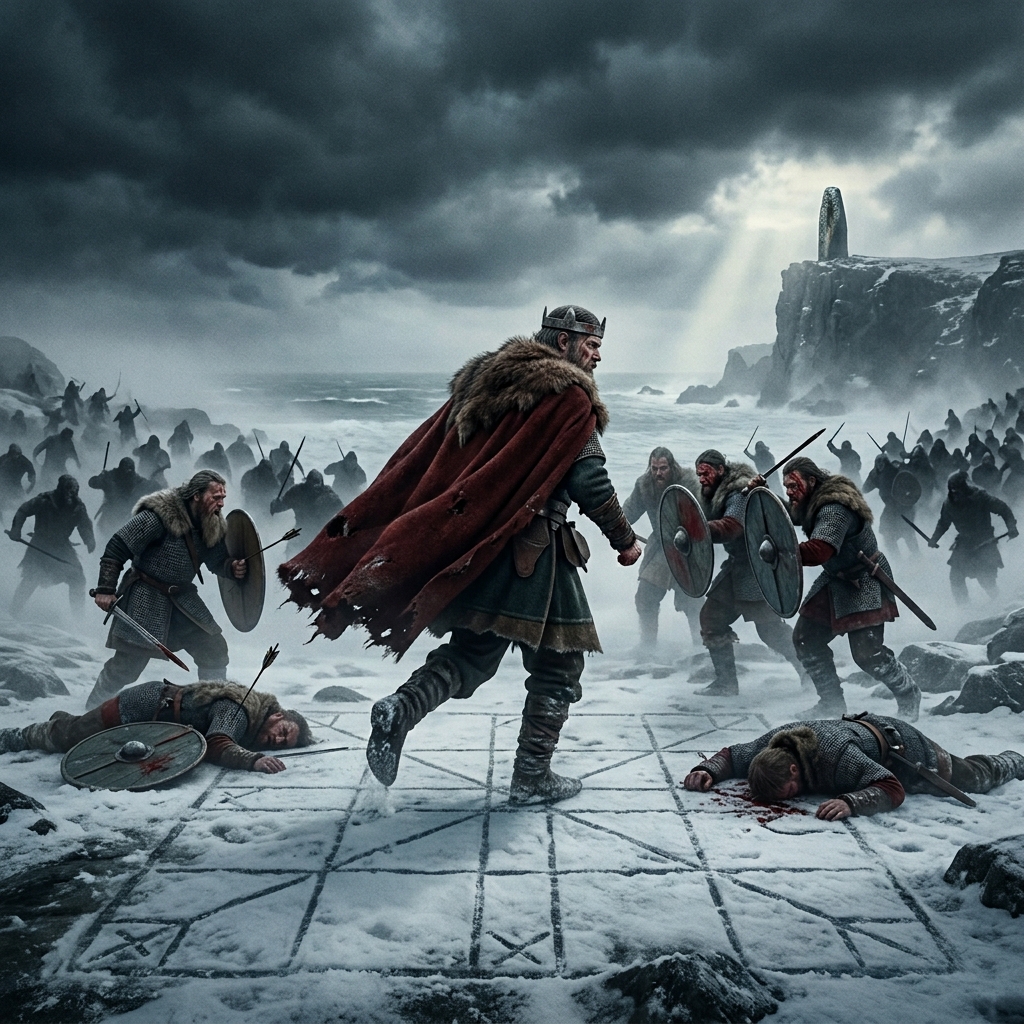
The king must run.
How to play Hnefatafl — the rules in plain words, in the order a beginner needs them, and the story of where the game comes from.
- Origin
- Scandinavia
- Era
- c. 400 CE
- Players
- Two
- To learn
- 11 min
The rules of Hnefatafl
In the order you need them. Each part takes a few minutes, and nothing in a later part is needed to understand an earlier one.
Part 1 · 3 min
Two sides, two jobs
Who's on the board, how they move, and the squares that belong to the king alone.
Two sides, two jobs
Twenty-four attackers on the edges. One king and twelve defenders in the centre. The attackers want the king. The king wants a corner — any of the four.
Pieces slide like a rook
Every piece moves in a straight line, any number of empty squares, but never diagonally and never jumping.
The throne is sacred
The four corner squares and the throne at the centre cannot hold any piece except the king. Attackers and defenders cannot move *through* them either — they have to stop at a neighbouring square.
Part 2 · 4 min
Capture: the squeeze
How a piece comes off the board — and the surprises a single sandwich move can spring on the position.
Sandwich an enemy to capture
Move your piece next to an enemy. If the square directly past that enemy holds another of your pieces — or a corner, or the empty throne — then the enemy is sandwiched and removed from the board.
You only capture by moving *into* the sandwich. A piece that walks itself between two enemies is safe — capture is always the attacker's reward, never the victim's mistake.
One move, two captures
A single move can complete more than one sandwich at once. Each direction around the landing square is checked separately — north, south, east, west. If your move closes a sandwich in two directions, both enemies leave the board together.
Corners count as your friends
Corners are always 'hostile' to non-king pieces — they back up any sandwich. The empty throne does too. So a piece next to a corner can be captured by just *one* attacker on the other side. The king is the only piece safe in those squares.
Part 3 · 4 min
The king's path, the king's fall
How the king escapes, how he is finally cornered, and the quiet defender move that forces the attacker to choose.
The king runs for a corner
Defenders win the moment the king reaches any of the four corner squares. The king slides like any other piece — straight lines, any distance, no jumps — but he is the only piece allowed to enter and exit the throne and the corners.
Cornering the king takes four
Other pieces fall to a sandwich of two. The king does not. He is captured only when he is hemmed in on all four sides at once — north, south, east, and west. Attackers count as walls. So do the throne and the edge of the board. But you still need four.
The defender's quiet weapon
Defenders rarely win by capturing — they win by buying time. Every move should give the king another safe square, or threaten to reach a corner from two directions at once. Force the attacker to choose, and one of the corners will be open.
Where Hnefatafl comes from
“That is a weak point, brother. But thou needest not change it.”
The game of the North
Long before chess reached Europe, the people of the North were already playing. Hnefatafl — the King's Table — was the strategy game of the Viking world.
Boards have been found in Iceland, Norway, Sweden, Ireland, Wales. Carved into the deck planks of longships. Buried in the graves of warriors. Scratched into the stones of Irish monasteries by Norse settlers.
Wherever the Vikings went, the King's Table went with them.
Not two equal armies
Look at the board. In the center, a king and twelve defenders — a small force, surrounded. At the edges, twenty-four attackers — twice their number, closing in.
The defenders do not need to win. They only need to get the king to a corner. The attackers do not need to lose anything. They only need to trap him.
This is not a battle between equals. This is a king trying to survive.
When the game spoke for him
An Icelandic saga, c. 14th century. Fridthjof the Bold sits in his hall, playing Hnefatafl with his brother Björn.
Hilding, his old foster-father, enters. He carries a message from two kings — they need Fridthjof's warriors for an oncoming war. Fridthjof does not look up. Instead, he speaks to Björn about the game.
"That is a weak point, brother. But thou needest not change it." "First it would be wise to move against his Hnefi — an easy choice."
Hilding rides back to the kings and explains: the weak point was their war. The move against the Hnefi was a threat against their rival king. Fridthjof never answered the messenger directly. He let the board speak for him.
Lost, then found again
When chess arrived in northern Europe, Hnefatafl began to fade. By the 1500s it was nearly gone. The rules were no longer taught. The boards were buried with their owners and forgotten.
Then, in 1732, the Swedish botanist Linnaeus traveled to Lapland and watched the Sámi people playing a strange game called tablut. He drew the board. He wrote down the rules.
It was the same game. The Vikings had survived in the far north. From his notes — and from the sagas, and the buried boards — we have rebuilt the game you are about to play.
The king must run
You don't need to be a Viking. You don't need to know the sagas. You don't need to send coded messages to your enemies.
You only need to choose a side — the king with his loyal few, or the many closing in — and remember that this is not a fair fight. It was never meant to be.
Now move.
Play Hnefatafl with a real person.
Board and Pieces puts Hnefatafl and ten other games of the world on one board — with your friends, your family, or whoever is sitting in the café. Free on iOS and Android.


Nobody near you yet?
Leave your city and an email. When there are players, or a café with a board, in your area, you hear about it first.


