How to play
Tavla
Five thousand years of luck.
How to play Tavla — the rules in plain words, in the order a beginner needs them, and the story of where the game comes from.
- Origin
- Mesopotamia
- Era
- c. 3000 BCE
- Players
- Two
- To learn
- 10 min
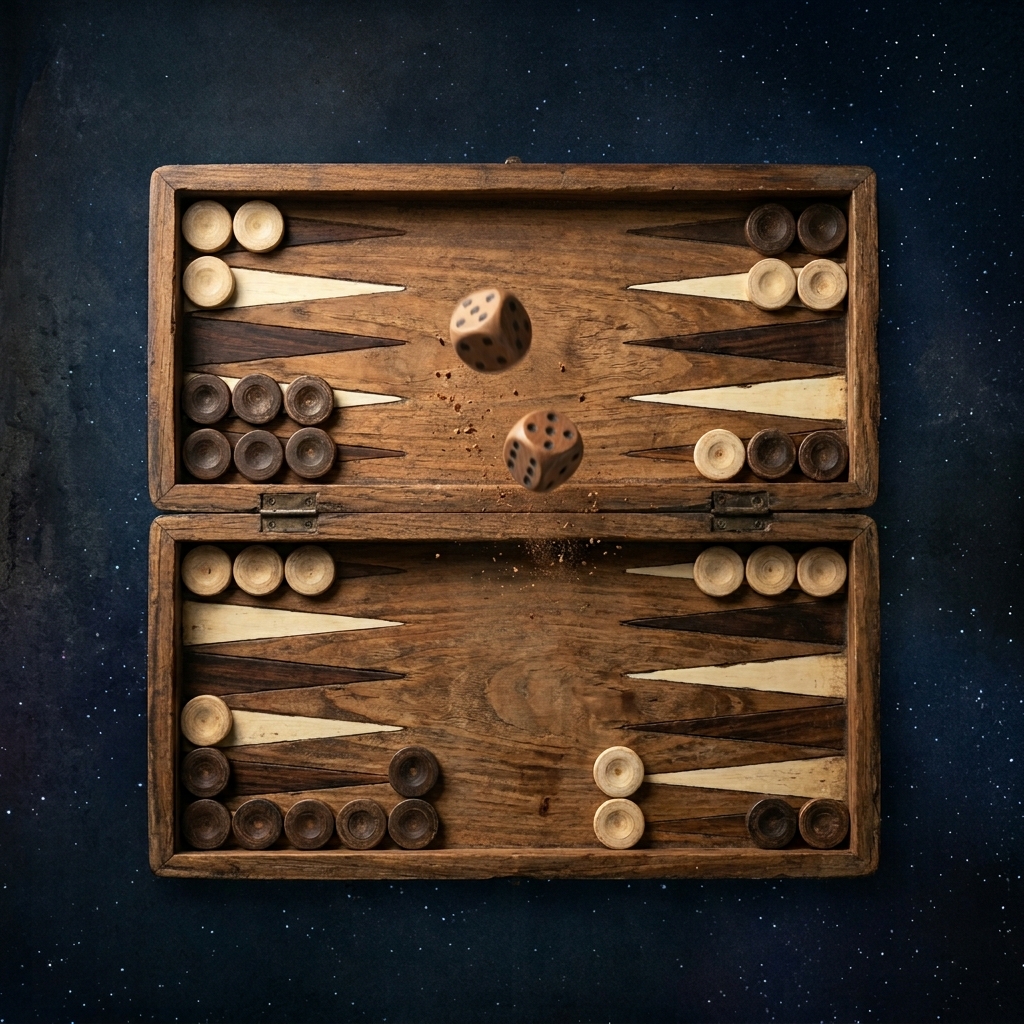
The rules of Tavla
In the order you need them. Each part takes a few minutes, and nothing in a later part is needed to understand an earlier one.
Part 1 · 3 min
Two players, fifteen stones each
The board, the dice, and the simple two-step rhythm of every Tavla turn.
Two players, fifteen stones each
The board has twenty-four points in two rows of twelve. White stones travel one way, black stones the other. Each player has fifteen stones laid out in the starting position.
Two dice, two moves
On your turn you roll two dice. Each die value is one move: pick a stone, slide it that many points forward. Use the dice separately, or use both on the same stone.
Doubles play four times
If both dice show the same number, you play that number four times instead of two. Doubles are the big swings.
Part 2 · 4 min
Two stones make a wall
Walls and blots, and what happens when one of your stones ends up on the bar.
Two stones make a wall
A point with two or more enemy stones is blocked — you can't land there. A single enemy stone is a target: land on it and the stone goes to the bar.
Bar first
If a stone of yours is on the bar, you must bring it back on the board before any other move — and you bring it on with one of your dice values. If neither die works, you skip the turn.
Part 3 · 3 min
All home, then bear off
The home stretch, the bear-off race, and the quiet truth that sometimes the dice leave you nothing to play.
All home, then bear off
Once every one of your stones has reached your home quarter — the last six points — you can start bearing them off. Roll a die, take a stone off the matching point. First side to bear off all fifteen wins.
Where Tavla comes from
“Three things refuse to obey my will: the waters of the Kamo River, the fall of the backgammon dice, and the monks of the Enryakuji Temple.”
Mesopotamia, 4500 years ago
In the royal tombs of Ur, archaeologists found a wooden board inlaid with shell and lapis lazuli. Twenty squares, a few dice, a handful of pieces.
It is the oldest known board game in human history. And its rules — the same one we still play today: roll, move, race for home.
Every empire gave it a name
The Egyptians called it Senet — the game of passing. Pharaohs were buried with their boards, ready to play through the afterlife.
The Persians called it Nard. The Romans, Tabula. The Byzantines played it in palaces, the Ottomans in coffeehouses.
Every culture changed the rules a little. Nobody changed the heart.
The two players at the table
Every game of tavla has two players. But really, there are three.
You decide where to move. Your opponent decides how to answer. And the dice — the dice decide what is possible.
This is why tavla has survived five thousand years. It is the only game where strategy and fate sit across from you at the same table.
The game in the room next door
Walk into a coffeehouse in Istanbul. A taverna in Athens. A teahouse in Tehran. A garden in Beirut.
Somewhere in that room, two people are sitting across from each other, throwing dice, laughing, arguing, drinking tea. The dice clatter, the pieces move, and the conversation never stops.
Tavla is not played alone.
Five thousand years of luck
You don't need to be skilled. You don't need to be lucky.
You only need someone across the table — and the willingness to let the dice surprise you.
Pick up the dice.
Play Tavla with a real person.
Board and Pieces puts Tavla and ten other games of the world on one board — with your friends, your family, or whoever is sitting in the café. Free on iOS and Android.


Nobody near you yet?
Leave your city and an email. When there are players, or a café with a board, in your area, you hear about it first.


