How to play
Patolli
The game the empire forbade.
How to play Patolli — the rules in plain words, in the order a beginner needs them, and the story of where the game comes from.
- Origin
- Mesoamerica
- Era
- c. 200 CE
- Players
- Two
- To learn
- 6 min
The rules of Patolli
In the order you need them. Each part takes a few minutes, and nothing in a later part is needed to understand an earlier one.
Part 1 · 2 min
A race around a cross
The cross, the beans, and the first token to step onto the board.
A race around a cross
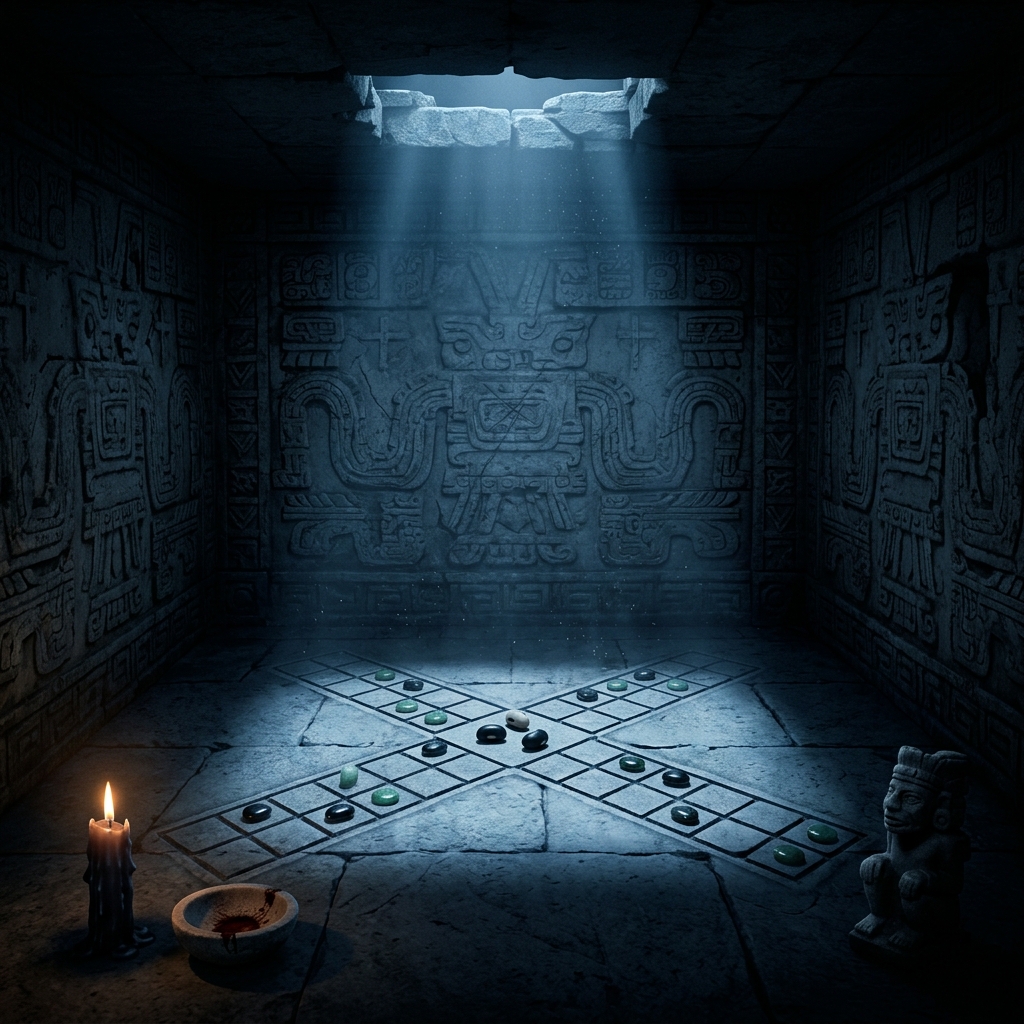
Patolli is played on a cross-shaped board of thirty-two cells. Each player has six tokens. The first to bring all six tokens home wins.
Five beans, not six dots
Instead of dice, you cast five small beans — each painted on one side. Count the flat sides facing up: that's how many cells you move.
All or nothing — bonus turn
If all five beans land flat-side up, you move ten cells and roll again. If none of them do, you move twenty cells and roll again. The lucky extremes are the prizes.
Part 2 · 2 min
Land on an enemy and send them home
Advancing along the cross, capturing enemies, and the four safe cells.
Land on an enemy and send them home
Land your token on a square where an opposing token sits, and that token goes back to its owner's hand — they'll have to start it again.
Four squares on the board are safe — no token can be captured there, no matter who lands beside it.
Part 3 · 2 min
Bring all six home
Finishing the lap and bearing your tokens off the board.
Bring all six home
Once a token finishes its lap around the cross, it leaves the board — borne off, safe forever. Bring all six tokens off to win.
Where Patolli comes from
“Although it be jade, it breaks. Although it be gold, it wears away. Although it be quetzal plumage, it is torn asunder. Not forever on earth; only a little while here.”
Tenochtitlan, before the fall
In the temples of the Aztec capital, players gathered around a board shaped like an X. On its arms, fifty-two spaces. Five beans marked with white dots served as dice.
They were not gambling. They were seeking signs from Macuilxochitl — the god of flowers, music, and games. Every throw was a prayer. Every move, a question.
From the palace to the street
Patolli was played by everyone. Farmers in courtyards. Nobles in palace halls. Montezuma himself kept professional players in his court.
And the stakes were real. Players wagered cocoa beans, cloaks, jewelry. Sometimes land. Sometimes their freedom. Some chronicles describe men who lost themselves into slavery on a single bad throw.
The game ran through Aztec life like blood through veins.
1519
Cortés arrived. Within two years, the Aztec Empire was gone.
The missionaries who followed found Patolli everywhere. They saw the prayers to Macuilxochitl. They saw the offerings before each throw. They called it idolatry.
The boards were burned. The dice were burned. Those who kept playing were punished, sometimes by death. Within a generation, a game three thousand years old was nearly extinguished.
What the friar wrote down
In hidden courtyards, some families kept playing. Quietly, without prayers, without the god's name spoken aloud. The game survived in whispers.
And then, an unexpected savior. Friar Bernardino de Sahagún — a Franciscan who arrived to convert — spent forty years documenting Aztec life in obsessive detail. He wrote down the rules of Patolli. He drew the board. He recorded the names.
He documented it to destroy it. Instead, he saved it.
The game the empire forbade
You don't need to pray to Macuilxochitl. You don't need to wager your freedom.
You only need to roll the beans, move your stones, and remember: this is a game someone once tried to erase from the world. They failed.
Pick up the beans.
Play Patolli with a real person.
Board and Pieces puts Patolli and ten other games of the world on one board — with your friends, your family, or whoever is sitting in the café. Free on iOS and Android.


Nobody near you yet?
Leave your city and an email. When there are players, or a café with a board, in your area, you hear about it first.


