How to play
Oware
Plant. Harvest. Repeat.
How to play Oware — the rules in plain words, in the order a beginner needs them, and the story of where the game comes from.
- Origin
- West Africa
- Era
- c. 1600 CE
- Players
- Two
- To learn
- 10 min
The rules of Oware
In the order you need them. Each part takes a few minutes, and nothing in a later part is needed to understand an earlier one.
Part 1 · 3 min
Twelve pits, two stores
The board, the goal, and the gentle motion of dropping seeds counter-clockwise around the pits.
Twelve pits, two stores
Each player has a row of six pits in front of them. Every pit starts with four seeds. Your row is the bottom; the empty bowl to its right is your store.
There are forty-eight seeds in play. The first player to gather more than half of them — twenty-five — wins the game.
Plant a handful, sow it around
To play, you pick up all the seeds from one of your pits and drop them, one at a time, into the next pits counter-clockwise — first along your own row, then up into your opponent's row.
Watch where the last seed lands. That's where the magic happens.
Part 2 · 4 min
Two or three — and they're yours
How the last seed turns into a captured handful — and how a long sow skips its own pit.
Two or three — and they're yours
Captures are the heart of Oware. If your last seed lands in an opponent's pit and brings the count there to exactly two or three, you take all the seeds in that pit. They go to your store.
Then comes the chain. Walk backwards from that pit — still in your opponent's row. As long as the next pit also reads two or three, you take those seeds too. The chain stops when you reach a pit with a different count, or when you cross back into your own row.
The chain has a stop
The chain stops at the first opponent pit that doesn't read two or three. Walking backwards, you look at the next pit's count — if it's four, five, one, or zero, the chain ends there. You keep what you've already taken; the rest stays on the board.
A long sow skips its own pit
If a pit holds twelve or more seeds, sowing once goes all the way around the board. When that happens, you skip your own source pit on the way back — leaving it empty instead of dropping a seed into it. The same is true of any longer sow that laps the board.
Part 3 · 3 min
Kindness, and the race to twenty-five
The rule that keeps your opponent in the game, and the score that ends it.
Don't starve your neighbour
You cannot make a move that leaves your opponent's row with no seeds at all — not while you still have a move that does leave them something. Oware is a game of patience; you can't simply scoop everything off the opposite side and walk away.
There's a single exception: if every move you have would leave them empty, then the forced move is allowed — and the game is about to end. Once your opponent has no legal move at all, the seeds still on the board sweep into the store of whoever just played. That's how Oware finishes.
And how it ends
Most games end on the seed count. Once one player's store holds at least twenty-five seeds, the result is decided — they have more than half, and the rest can no longer change that.
Twenty-four to twenty-four is a draw. Anything else, the side with more seeds wins. Oware doesn't care how you got there; it cares only that you got there first.
Where Oware comes from
“A man and a woman played Oware so long, they could not part. So they married, that the game might never end.”
Older than the pyramids
Across Africa, in the rocks of Ethiopia, the temples of Egypt, the deserts of Sudan, archaeologists keep finding the same pattern: two rows of small pits, scooped into stone or carved into wood.
Some are six thousand years old. The mancala family of games may be the oldest games humans have ever played. Oware is its most beloved descendant.
Under the tree, every afternoon
In an Akan village, two elders sit under a baobab or a kapok tree, an oware board between them. Around them, children gather to watch.
The children are not playing. They are learning. How to count seeds by twos and threes. How to wait. How to read an opponent's mind. How to lose without complaint, and win without pride.
Oware is one of the first classrooms an Akan child knows.
When the village argues
Two neighbors disagree. A boundary stone. An unpaid debt. A grandfather's land, divided badly.
The elder brings out the board. They will play Oware. They will play until one wins. And while they play, they will speak — calmly, because no one shouts over an Oware board. By the time the game ends, the argument has often ended too.
The board is a kind of judge — one that asks both sides to sit down, breathe, and count.
Plant. Sow. Harvest.
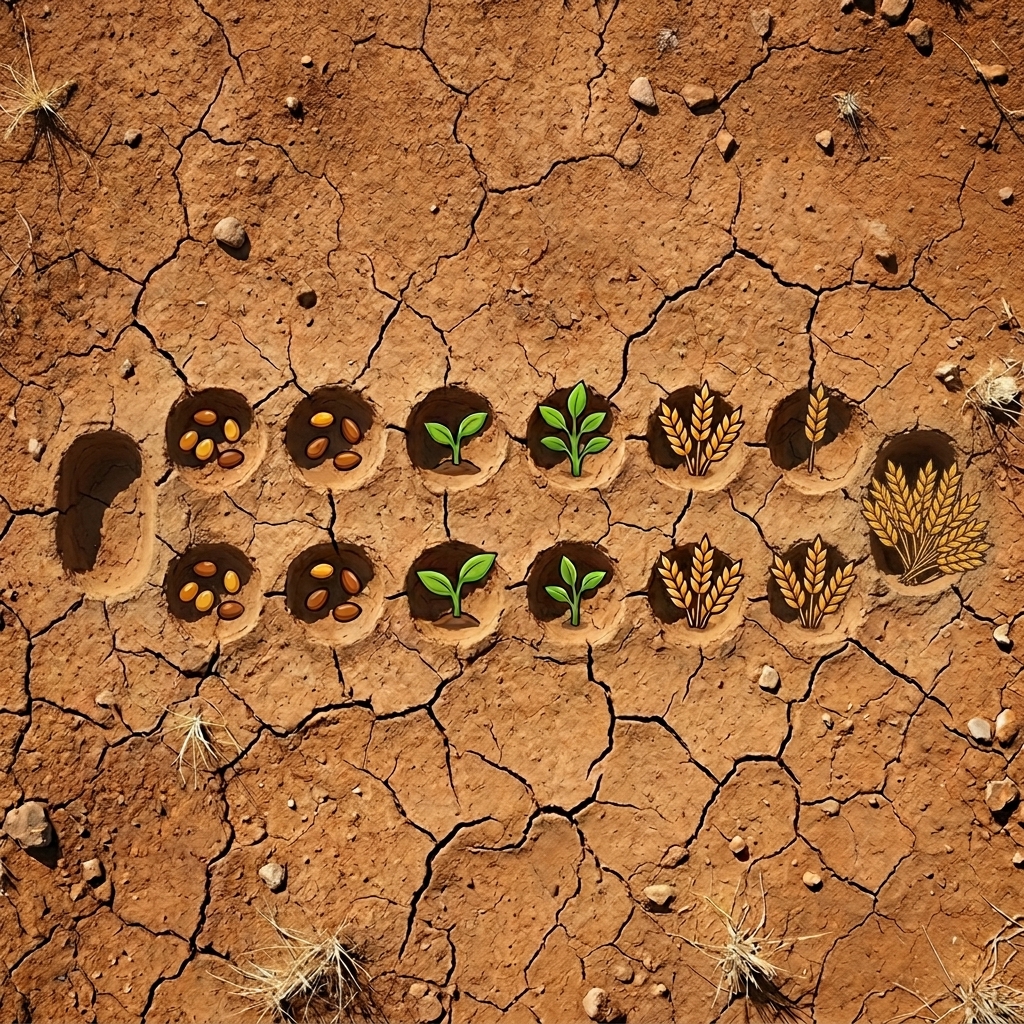
Look closely at the game. The pits are fields. The seeds are seeds. You plant by picking up a handful. You sow by dropping one into each field you pass. You harvest from the field that ripens — exactly two, exactly three.
An Akan child learning Oware is also learning the rhythm of the farm. Not a metaphor. A rehearsal.
Plant. Harvest. Repeat.
You don't need to be a farmer. You don't need to be Akan. You don't need to know how to count seeds by twos and threes.
You only need someone across the board, and a few minutes of patience. The seeds will teach you the rest.
Pick up the seeds.
Play Oware with a real person.
Board and Pieces puts Oware and ten other games of the world on one board — with your friends, your family, or whoever is sitting in the café. Free on iOS and Android.


Nobody near you yet?
Leave your city and an email. When there are players, or a café with a board, in your area, you hear about it first.


