For café owners
How to run board game nights in an ordinary café
You do not need to become a board game café to get the benefit of one. Here is how to add games to a café that mostly sells coffee — including the mistakes that cost the most money at the start.
Decide which of two businesses you are running
A board game café is a venue where the games are the product. People pay a table fee, stay three hours, and the kitchen is built around food that can be eaten without wrecking a board. It is a real business, and it is a different one from yours.
What most cafés actually want is the second thing: games as a reason to stay, on top of a business that still sells coffee. That version is far cheaper to try and far easier to reverse, and almost everything below assumes it.
The distinction matters because the two fail differently. A game café fails if the collection is thin. A café with games fails if the games get in the way of service — if tables are occupied for three hours at the price of a flat white, you have bought yourself a problem.
Do not buy a big collection
The instinct is to buy thirty boxes. It is the most common expensive mistake, and it is wrong for three separate reasons.
A large collection is intimidating rather than inviting — faced with a wall of unfamiliar boxes, most customers pick nothing. It is also expensive to maintain: boxes get damaged, pieces disappear, and after a year you own thirty incomplete games. And it commits you before you know whether anyone in your neighbourhood wants this.
Six to eight games, chosen well, will outperform thirty. Nearly all play goes to a handful of titles anyway.
Two everyone already knows
Chess and backgammon, or whatever the equivalents are where you are. Nobody needs the rules explained, which is the single biggest barrier to a stranger starting.
Two that take under fifteen minutes
Short games get played by people who are unsure. Long games get looked at.
Two that work for four people
A group of four is the most profitable table you have and the hardest to occupy.
Nothing with two hundred pieces
Whatever you buy, you are the one who counts it back into the box at closing.
Set the table rules before you need them
The awkward conversation — a table of four, four hours, two coffees — is entirely avoidable, and only if you decide the policy before it happens rather than during it.
Whatever you choose, write it on the card that sits with the games. A stated rule is not resented; an improvised one is.
Decide on a minimum, or decide not to have one
"One drink per person per hour" is common and clear. So is deciding you would rather have a full-looking room. Both work. Ambiguity does not.
Protect the peak
Many cafés allow games at all times except the lunch rush. That is a reasonable thing to say out loud, and nobody argues with it.
Name a closing time for boards
Half an hour before you close, so you are not waiting on the last game while stacking chairs.
Run one night, not a whole programme
One recurring evening beats games-available-always for the first few months. It concentrates the people who want this into the same room at the same time, which is the only way strangers end up playing each other. Scattered across the week, the same number of people never meet.
Pick a night that is currently quiet — a Tuesday or a Wednesday — and keep it for at least two months before judging. The first one will be small. The fourth is the one that tells you anything.
Somebody has to host it, at least at the start: someone who greets people arriving alone and puts them at a table with someone else. That is the entire job, and without it a game night is a room of people who came separately and left separately.
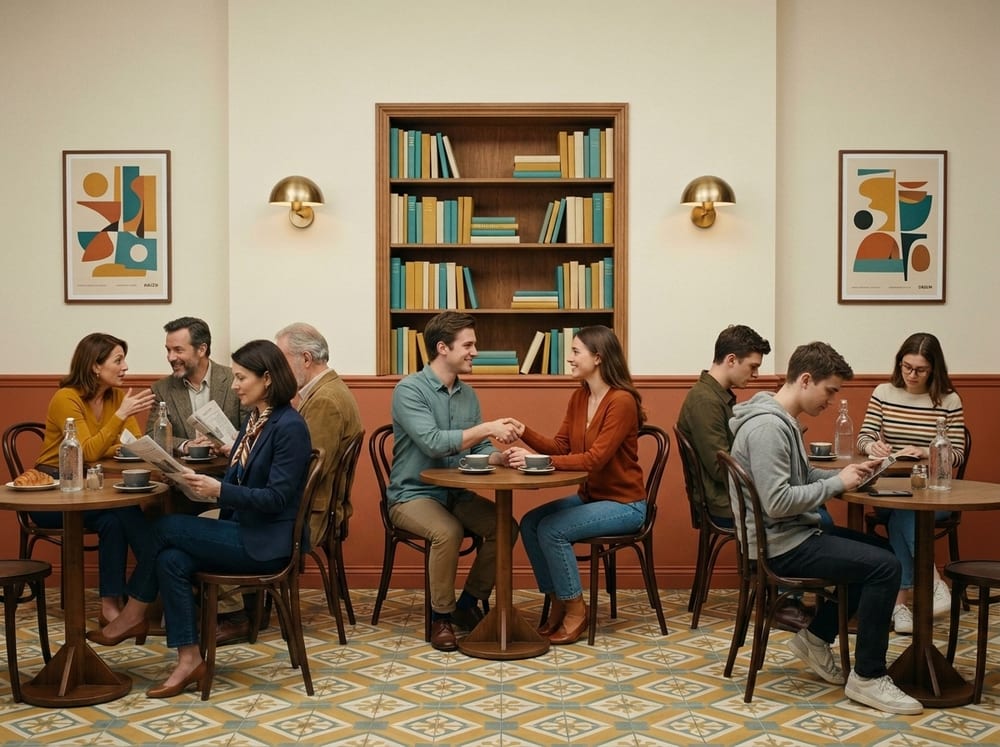
Consider skipping the boxes altogether
Every problem above — the cost, the missing pieces, the storage, the counting at closing — comes from owning physical games rather than from playing them.
This is where our own product is the honest answer, and we will say it once. Board & Pieces puts the games on your guests’ own phones, and while your venue is sponsored, every game played at your tables is free for whoever is sitting at them. You print a code for the tables; there is nothing to buy, store or replace. Guests also see your café in the app when they are looking for somewhere to play, which is the part a shelf of boxes cannot do.
It is not a replacement for the atmosphere of a real board on a table, and we would not claim otherwise. It is a way of finding out whether your neighbourhood wants this at all before you spend anything on boxes.
The four mistakes that cost the most
Every one of these is common, and every one is avoidable by deciding something in advance.
Buying the collection first
Spend the money after you know people come, not in the hope that they will.
Having no table policy
The conversation happens eventually. Have it with a card on the table rather than with a customer.
Giving up in week two
A game night is a habit, and habits take about a month. Most are abandoned before they were ever going to work.
Not telling anyone outside the café
An event only your regulars know about rearranges your existing customers. It does not add any.