How to play
Nine Men's Morris
Three in a row. Three thousand years.
How to play Nine Men's Morris — the rules in plain words, in the order a beginner needs them, and the story of where the game comes from.
- Origin
- Roman Empire
- Era
- c. 50 CE
- Players
- Two
- To learn
- 6 min
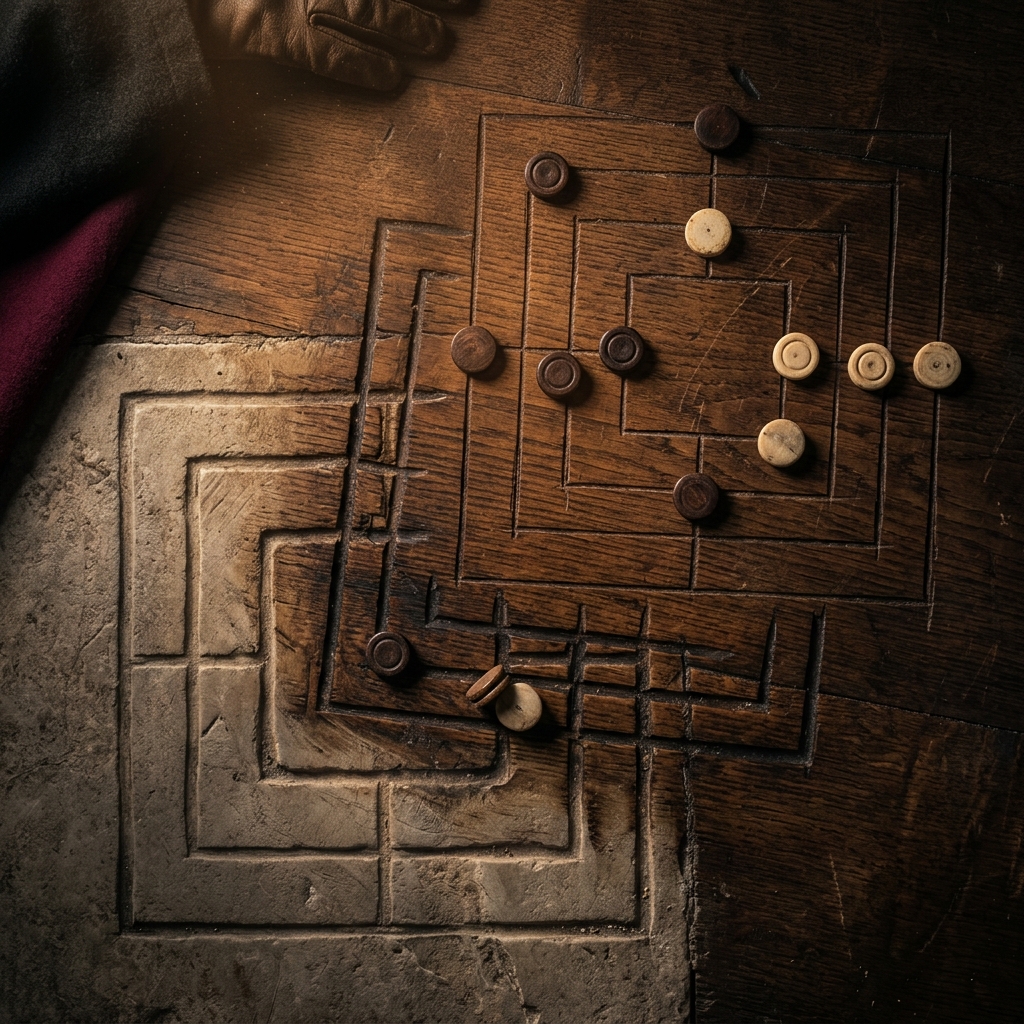
The rules of Nine Men's Morris
In the order you need them. Each part takes a few minutes, and nothing in a later part is needed to understand an earlier one.
Part 1 · 2 min
Nine pieces, twenty-four points
The board, the nine pieces, and the very first mill.
Nine pieces, twenty-four points
Each player has nine pieces. The board is three nested squares connected by short lines. Twenty-four intersections in all.
Phase one — placing
You take turns dropping one piece on any empty point. Once both players have placed all nine, the placing phase ends.
Three in a row makes a mill
Three of your pieces on a single straight line is a mill. Every time you form a new mill, you take one of your opponent's pieces off the board.
Part 2 · 3 min
Choose what you take
Choosing the piece to take, and watching the board open up when no one drops new pieces any more.
Choose what you take
When you form a mill, you don't have to take any random opponent piece. Pick the one that hurts them most — usually one that's almost building its own mill, or one that's about to slide into a key point.
Phase two — sliding
Once both players have placed all nine, you can no longer drop new pieces. Instead, each turn you slide one of your pieces along a line to a neighbouring empty point.
Part 3 · 1 min
Two ways to win
How the game finishes — by emptying your opponent's pieces or their possibilities.
Two ways to win
You win when your opponent has only two pieces left — they can't form a mill any more. Or when they have no legal move at all.
Where Nine Men's Morris comes from
“The nine men's morris is filled up with mud. The quaint mazes in the wanton green, for lack of tread, are undistinguishable.”
Egypt, 1400 BCE
On the roof tiles of the temple of Seti I at Kurna, a worker scratched a board into the stone — three squares within squares, connected by lines.
He played it while the pharaoh's masons worked above him. He has been dead three thousand years. The board is still there.
Rome, 100 CE
Fifteen centuries later, Roman soldiers scratched the same board into the marble steps of the Forum.
They played while waiting for orders, for ceremonies, for the slow march of empire. The boards are still visible — under stones where Caesar walked.
And everywhere else
Viking sailors scratched it into the planks of their longships. Medieval monks carved it into the wooden seats of their churches, while sermons droned on above them.
Soldiers in Sri Lanka. Traders in Mali. Shepherds in the Alps. The same board, in stone, in wood, in dirt — wherever someone had time to fill, and a stick to scratch with.
Why this game?
The Egyptian, the Roman, the Viking, the monk — none of them knew about the others.
But they all carved the same nine points, the same three-in-a-row, the same simple beautiful pattern. Something about this board fits the human mind. Something about it arises wherever people gather and wait.
Civilization may not have invented this game. The game may have invented itself, again and again, in every century, in every land.
Three in a row. Three thousand years.
You don't need to know its history. You don't need to know its rules.
You only need someone across the table, and a few minutes to fill. The same minutes the Egyptian had. The same minutes the Roman had. The same minutes the monk had.
Three in a row. That's the whole game.
Play Nine Men's Morris with a real person.
Board and Pieces puts Nine Men's Morris and ten other games of the world on one board — with your friends, your family, or whoever is sitting in the café. Free on iOS and Android.


Nobody near you yet?
Leave your city and an email. When there are players, or a café with a board, in your area, you hear about it first.


